How To Become a Nurse
01/15/2026
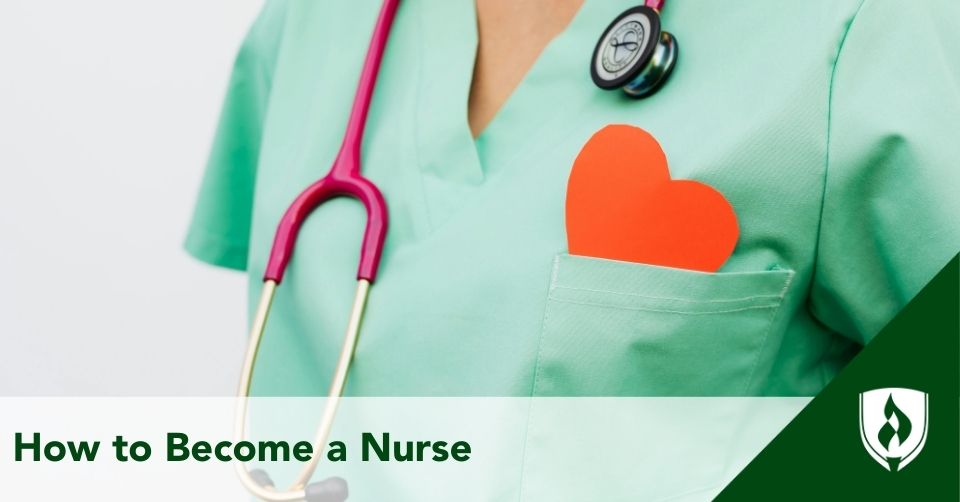
A nursing career typically involves1 direct patient care, patient education, and collaboration with other healthcare professionals.
Nurses may practice in a variety of healthcare settings, including1:
Hospitals
Nursing care facilities
Outpatient clinics
Long-term care facilities
Schools
Community health programs
Whether you're seeking an associate degree in nursing, bachelor's degree, or advanced education, the journey to become a nurse may include completing an approved nursing program, gaining clinical experience, obtaining a nursing license, and pursuing specialty preparation.
Reasons To Consider a Nursing Career
According to the American Association of Colleges of Nursing,2 there are approximately 4 million registered nurses in the U.S.; this makes nursing among the largest groups of healthcare workers with more than 100 nursing specialties.
A nursing degree typically allows you to directly impact1 the health and well-being of patients. Nurses typically develop3 a combination of clinical, communication, and problem-solving skills, and work closely with patients to support their recovery, wellness, and long-term care.
Steps To Become a Nurse
While the exact path for each person may vary, how to become a nurse generally follows these key steps:
- Choose Which Nursing Pathway Is Right for You
Decide whether you want4 to be a Certified Nursing Assistant (CNA), Licensed Practical Nurse (LPN), or a registered nurse (RN), or start with a bachelor’s or graduate-level program. Complete an Accredited Nursing Program
Enroll in an approved nursing program4, such as an LPN diploma, associate degree in nursing (ADN program), bachelor of science in nursing (BSN), or graduate-level program which may help students develop foundational knowledge in science in nursing, nursing practice, and patient care.Gain Clinical Experience
Participate in labs,4 simulations, and clinical rotations to apply nursing theory in patient care settings. Training may include work in intensive care units, emergency rooms, nursing homes, home health nurse settings, and outpatient nurse programs.Obtain Licensure or Certification
Pass the National Council Licensure Examination® (NCLEX) for LPNs or NCLEX-PN®, NCLEX-RN® (for RNs), or earn CNA certification to begin professional practice.5 Advanced practice roles may require additional licensure or specialty certification.Start Employment and Explore Specialties
Explore health care opportunities while gaining experience and identifying areas of interest or who you'd like to shadow, such as critical care nurses, a certified nurse midwife, addiction nurses, an oncology nurse, a nurse scientist, or nurse educators.
Nursing Entrance Exams
Nursing entrance exams are typically6 an essential step for entering programs, as they assess foundational knowledge, critical thinking, and academic skills that may be needed to help students prepare for nursing school. Common exams may include the TEAS, HESI A2, NLN PAX, and PSB Aptitude Exam, each evaluating areas such as reading comprehension, math, science, and verbal skills.
HESI A2: May focus on reading, vocabulary, math, and anatomy/physiology. Test duration is typically 3-4 hours, with passing scores generally between 75-85% with registration fees based on your location and how you take the exam.
TEAS: Typically covers reading, math, English, and science. The exam lasts approximately 209 minutes and may have registration fees. Rasmussen may allow applicants with a bachelor’s degree in nursing or higher and a GPA of 2.25+ to skip the TEAS.
NLN PAX: May test reading, math, and science over 125 minutes. Registration fees may apply.
PSB Aptitude Exam: May assess academic skills, practical abilities, and vocational suitability in healthcare. Exam duration is 2-2.5 hours, with registration fees.
Nursing schools typically set their own passing requirements, and Rasmussen University does not accept every exam listed, so applicants should review the School of Nursing Entrance Exam policy in the course catalog.7 Preparing early, using study guides, and taking practice tests are recommended strategies to navigate these exams.
Nursing Education Options at Rasmussen University
Rasmussen University typically offers4 a range of structured pathways from entry-level nursing graduates through advanced practice registered nurse roles, depending on your prior experience and career goals.
Practical Nursing (LPN): Entry-level, direct patient care program8 intended to help prepare students for practical nursing licensure.
Professional Nursing (ADN/RN): An associate degree in nursing9 combining coursework, labs, and clinical practicums to help prepare students for RN licensure. Students can choose from multiple start dates, and no prior nursing coursework is required.
Bachelor of Science in Nursing (BSN): May offer three entry options:10
Standard BSN for students without prior nursing education
Accelerated BSN for those with a previous bachelor’s degree in nursing
RN to BSN Program for licensed RNs
Rasmussen University offers online and on-campus courses and onsite clinicals. Nursing faculty and other BSN students will work together in state-of-the-art simulation centers and updated labs to practice real-world scenarios. Rasmussen University’s Bachelor of Science in Nursing (BSN) programs are accredited by the Commission on Collegiate Nursing Education.* The program holds a 93% rating for BSN students in Minnesota who passed the NCLEX-RN® in 2023.**
Graduate-Level Programs (MSN, MSN-NP, Post-Graduate Certificates, DNP): Designed for advanced4 practice, leadership, or specialty roles. Both graduate or master's degree programs include local practicum or practice experiences.
MSN programs may include11 specialties such as Nursing Education, Nursing Leadership and Administration, and Healthcare Technology, Simulation, and Informatics.
DNP programs may offer specializations12 in Executive Leadership and Public Health and Policy.
Nursing Licensure and Certification Requirements
Specific license or certification requirements may be useful for nurses, including those with a nursing diploma, to prepare for their specific roles. These standardized tests are typically required by state nursing boards and regulatory agencies to grant licensure.
Licensure requirements vary by role:5
Certified Nursing Assistant (CNA): May provide13 foundational care for patients who are under supervision. CNAs typically work under LPNs and/or RNs to help them in providing patient care.
Licensed Practical Nurse (LPN): Completion of an LPN program and passing the NCLEX-PN®.
Registered Nurse (RN program): Completion of an ADN or BSN program and passing the NCLEX-RN®.
Requirements vary by state but may include completion of an approved program and passing the NCLEX-PN®/NCLEX-RN®
Beginning Employment and Choosing a Specialty
After earning licensure, individuals may pursue nursing roles in various health care settings. Common areas may include2 private practices, health maintenance organizations, public health nurse, primary care nursing, home health, nursing homes, minute clinics, outpatient care nurse, schools, mental health agencies, hospices, the military, and more, depending on employer, state regulations, and market conditions.
Advancing Your Nursing Career
After completing an accredited program and earning licensure, nurses can continue building expertise, explore specialty areas, such as psychiatric mental health or pursue advanced degrees in nursing. Career paths may include bedside care, community health, occupational health, and leadership roles. Continuing education, certifications, and graduate programs4 may provide nursing pathways for further skill development and professional growth.
The roles mentioned in this article are provided as general examples of typical career paths within the nursing field and should not be interpreted as assurances of employment or eligibility for any specific position.
American Nurses Association® is a registered trademark of American Nurses Association 8515 Georgia Ave, suite 400 Silver Spring, MARYLAND UNITED STATES 20910.
American Association of Colleges of Nursing Suite 750 655 K Street Washington, DISTRICT OF COLUMBIA 20001.
NCLEX® is a registered trademark of National Council of State Boards of Nursing, Inc. 111 East Wacker Drive Suite 2900 Chicago, ILLINOIS UNITED STATES 60601
NCLEX-PN® is a registered trademark of National Council of State Boards of Nursing, Inc. 111 East Wacker Drive Suite 2900 Chicago, Illinois, United States 60601
NCLEX-RN® is a registered trademark of National Council of State Boards of Nursing, Inc. 111 East Wacker Drive Suite 2900 Chicago, ILLINOIS UNITED STATES 60601
*The baccalaureate degree program in nursing at Rasmussen University is accredited by the Commission on Collegiate Nursing Education (CCNE), 655 K Street, NW Suite 750, Washington, DC 20001, 202-887-6791.
**121 of the 130 Rasmussen University BSN graduates in Minnesota (93%) who attempted the NCLEX-RN exam in 2023 passed on their first attempt. Source: https://mn.gov/boards/assets/2023_Annual_Educ_Rpt_tcm21-616787.pdf. Accessed February 5, 2023.
1American Nurses Association® (ANA), What Is Nursing?, at https://www.nursingworld.org/practice-policy/workforce/what-is-nursing/ (accessed Dec. 1, 2025).
2American Association of Colleges of Nursing (AACN), Nursing Workforce Fact Sheet, at https://www.aacnnursing.org/news-data/fact-sheets/nursing-workforce-fact-sheet (accessed Dec. 1, 2025).
3Bureau of Labor Statistics, U.S. Department of Labor, Occupational Outlook Handbook, Registered Nurses, at https://www.bls.gov/ooh/healthcare/registered-nurses.htm#tab-4 (accessed Dec. 1, 2025). Employment conditions in your area may vary.
4Rasmussen University, Nursing Degree Programs, at https://www.rasmussen.edu/degrees/nursing/ (accessed Dec. 1, 2025).
5Rasmussen University, What Is the NCLEX?, at https://www.rasmussen.edu/degrees/nursing/blog/what-is-the-nclex/ (accessed Dec. 1, 2025).
6Rasmussen University, Nursing Entrance Exam, at https://www.rasmussen.edu/degrees/nursing/nursing-entrance-exam/ (accessed Dec. 1, 2025).
7Rasmussen University, 2025–2026 Catalog (page 102), at https://rasmussen.dcatalog.com/v/2025-2026-Catalog/?page=102 (accessed Dec. 1, 2025).
8Rasmussen University, Practical Nursing Program, at https://www.rasmussen.edu/degrees/nursing/practical-nursing/ (accessed Dec. 1, 2025).
9Rasmussen University, Professional Nursing Program, at https://www.rasmussen.edu/degrees/nursing/professional-nursing/ (accessed Dec. 1, 2025).
10Rasmussen University, Bachelor of Science in Nursing, at https://www.rasmussen.edu/degrees/nursing/bachelor-science-nursing-bsn/ (accessed Dec. 1, 2025).
11Rasmussen University, Master of Science in Nursing (MSN) Specialties, at https://www.rasmussen.edu/degrees/nursing/master-science-nursing/msn-specialties/ (accessed Dec. 1, 2025).
12Rasmussen University, Doctor of Nursing Practice Program, at https://www.rasmussen.edu/degrees/nursing/doctor-nursing-practice/ (accessed Dec. 1, 2025).
13American Red Cross, Certified Nursing Assistant (CNA) Training, at https://www.redcross.org/take-a-class/lp/certified-nursing-assistant-nat (accessed Dec. 1, 2025).